Calculate every class
Magnitude, altitude, darkness, duration and Moon distance apply to every selected catalogue object. The three additive orbit switches filter views and exports after calculation.
Windows · Photometry · Mutual events
Select known systems and evidence-based candidates by visibility, orbit quality and attainable brightness change.
Windows application · setup and portable package
DoppelasteroidenPlaner combines a local ephemeris collection with a searchable station list. It provides nightly priorities, suitable nights per object and, in its fifth tab, one reasoned primary target for every night. Scientific inputs retain their sources, units and unresolved uncertainties.
Getting startedLiterature review
548 nights · 17 suitable objects · 1399 target-nights at defaults
At the hard 0.20 mag threshold, no geometric mutual-event candidate remains in the current interval. Daily targets are visibility and monitoring recommendations, not confirmed occultation dates. All 1,076 objects are calculated before display selections.
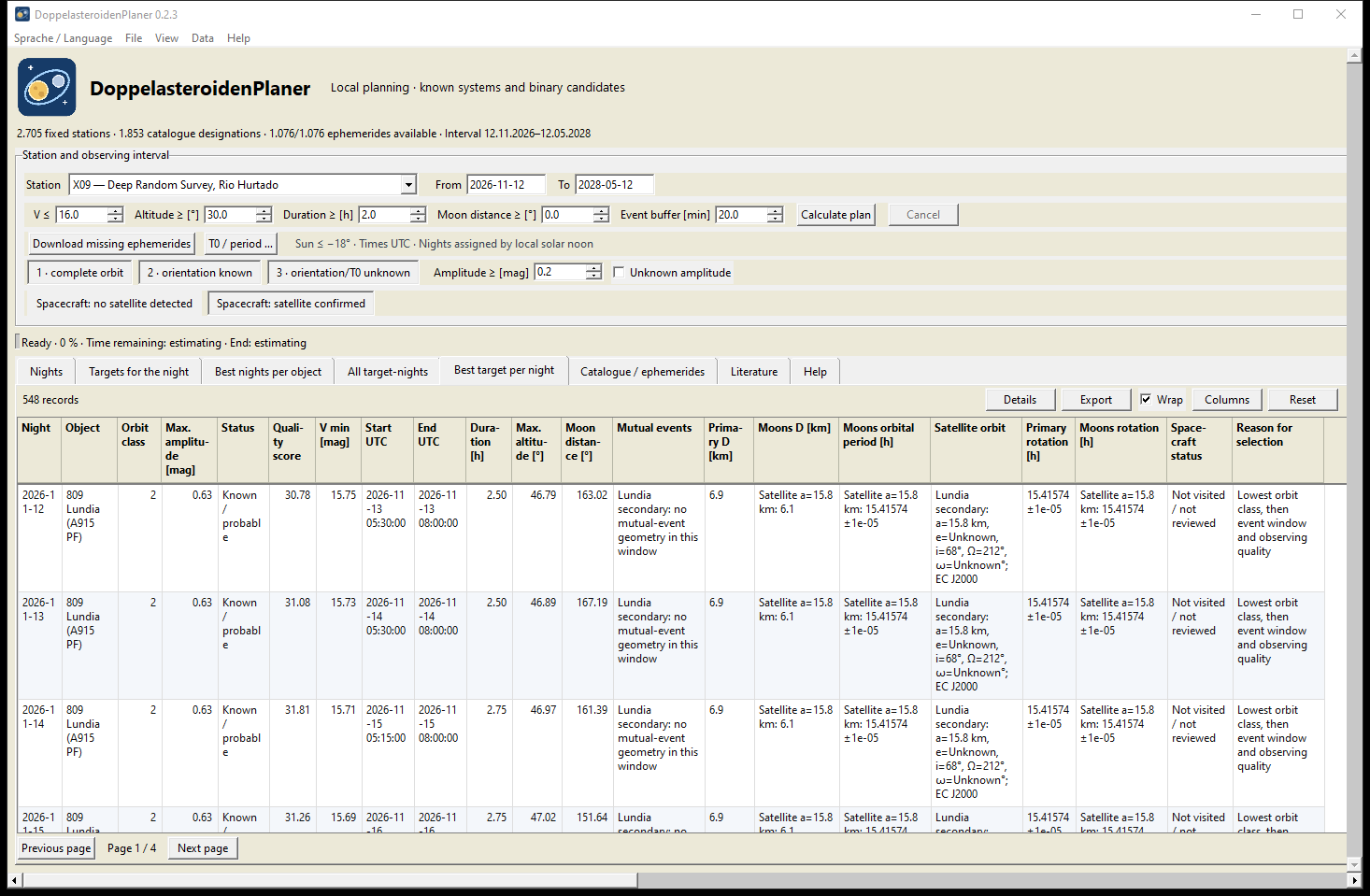
Magnitude, altitude, darkness, duration and Moon distance apply to every selected catalogue object. The three additive orbit switches filter views and exports after calculation.
A lower class wins before the observing score. Within a class, suitable event windows come first, followed by duration, altitude, brightness and Moon distance.
Maximum model amplitude is a hard lower threshold. Unknown values have a separate switch. A conditional upper bound does not promise that depth on a particular night.
Visited objects without a detected satellite are hidden by default. Spacecraft-confirmed satellites have their own switch. Contact lobes and temporarily orbiting dust are not counted as additional stable moons.
Tables distinguish primary/moon diameters, mutual orbital periods and elements, and independent rotation periods. An unavailable measurement remains unknown.
Station, dates, thresholds, class switches, spacecraft filters, language and table layout persist locally. German and English are available from the language menu.
| Class | Orbit knowledge | Meaning |
|---|---|---|
| 1 | Complete orbit | Orientation, sizes, epoch and period allow geometric model times. Long-term phase and dynamical validity remain separately qualified. |
| 2 | Known orientation | An uncertain phase, size or time convention permits only possible event geometry. No precise event time is invented. |
| 3 | Unknown orientation/T0 | Visibility and photometric monitoring can be planned. No mutual-event time is asserted. |
The review covers peer-reviewed papers, author preprints, publisher pages and official NASA/JPL, MPC and IMCCE documentation. Searches focused on absolute phase epochs, mutual periods, reference frames, component radii and their uncertainties. This is a documented targeted review, not a claim to have exhaustively reviewed every publication on every binary asteroid. Retrieval date: 12 November 2026.
Not every retrieved number is activated. Rotation periods are not relabelled orbital periods, and an orbit epoch is not a minimum T0. An unresolved time scale, body-related frame or required precession prevents an unqualified conversion. Conflicting or only second-hand numerical claims remain open literature questions.
Resolved spacecraft images, adaptive optics, radar and repeated mutual events support detections in different ways. Astrometric wobble adds candidates. These evidence types are not interchangeable. Gaia periods can be ambiguous and need independent confirmation.
Antiope and Lundia illustrate that a precise period and known pole do not supply event dates without an absolute phase zero. Patroclus has an explicit UTC epoch. Kalliope, Elektra and triples illustrate how additional dynamical terms and correct angle definitions can be essential to propagation.
Original 1σ/3σ confidence levels are preserved; internal conversion of a known 3σ value is documented. Without covariance, quadrature is only an independent-error approximation. Unknown total uncertainty remains unknown and receives no bonus for a guaranteed fully fitting event window.
Rotation, shape, occultation and eclipse can all cause deep light curves, but are different effects. Without direct measurements, the current threshold uses an explicitly conditional central-occultation bound from component areas. It does not replace light-curve inversion, weather assessment or an actual event-profile measurement.
P=16.505046 ±0.000005 h, pole λ=199°, β=38° ±5°, radii 40.4/40.2 ±0.9 km, separation 176 ±4 km. The table supplies no absolute phase epoch. Used for orientation/sizes, without inventing T0.
P=15.41574 ±0.00001 h and pole (122°,22°) ±5°. A precise period does not replace an epoch of minimum. Observed amplitudes depend strongly on aspect; a single season is not treated as a constant amplitude.
Complete circular orbit: P=4.282680 ±0.000063 d, a=688.5 ±4.7 km; epoch JD 2457900 explicitly means 2017-05-26 12:00 UTC. Mean longitude 110.1° ±3.6°, i=164.11° ±0.61°, Ω=269.3° ±1.8°. Original 1σ uncertainties are retained. Newer solutions exist; this older adopted solution remains labelled.
A newer fit combines astrometry and mutual events and is the preferred follow-up reference for a precision update. Reliable full-text access was unavailable in this retrieval; missing angles/epochs are not assembled from secondary quotations.
Full osculating elements are imported through the documented JPL satellite API using TDB. The paper fits a three-body model and reports rapid nodal/apsidal precession. The app labels Kepler candidates with unknown total timing uncertainty, rather than claiming accurate 2027 timings. These are not simple linear T0/P minima.
Two moons have P=3.71234 ±0.00004 d and 1.376 ±0.016 d (3σ). Table 1 supplies elements and periapsis epochs without explicitly declaring the epoch time scale. Periods, sizes and orientation are recorded; the unresolved time scale blocks an unqualified phase import. The inner moon has large uncertainties.
Astrometry over 3783 days constrains P=1.137446 ±0.000009 d. The study includes a Kepler orbit, sizes and the primary’s independent spin. Adopted partial parameters retain their confidence level and any unresolved phase/time-scale information.
Updated Pulcova and Emma solutions. Pulcova: P=4.14321 ±0.00038 d, a=738.4 ±2.6 km; moon 14 ±4 km. Emma requires non-Keplerian gravity; a fixed Kepler orbit fails over long intervals. These revisions show why more decimal places do not guarantee dynamical validity.
New astrometry and orbital solutions for widely separated systems. Long periods, broad ephemeris uncertainties and rare alignments can limit mutual-event observations. A satellite may be much fainter than the system’s V=16 selection. A complete element table alone does not always supply a usable minimum ephemeris without an explicit time convention.
T0=2459546.692102 TDB is explicit, but the model includes multipoles, internal/external tides and a body-related frame. Treating those angles as a simple EQJ2000 orbit would be wrong. Documented as a limit of the app’s simple model, without fabricating a precise minimum sequence.
Osculating elements at JD 2457021.567880 TDB describe a multi-moon system. True longitude, mean anomaly and longitude of periapsis are different quantities. The study illustrates why an epoch alone does not justify a simple Kepler extrapolation.
The orbital period 16.1508 ±0.0002 h, pole (266°,−83°) ±4° and size ratio 0.29 ±0.02 have 3σ errors. Primary spin 3.595195 ±0.000003 h is distinct. Quadratic phase evolution is examined; no event sequence is invented without an adopted absolute phase zero.
P=1.7556 ±0.0015 d and a=2.659 ±0.08 km; primary spin 2.7745 ±0.0007 h, secondary spin about 1.77 ±0.02 d. Precession is discussed. Sizes and independent spins improve the physical fields; missing long-term phase information is not invented.
The DART impact changed the mutual period and was followed by further time-dependent evolution. Pre-impact ephemerides are not current Dimorphos predictions. The paper’s 3σ uncertainties must not be presented as 1σ.
Lucy resolved Dinkinesh and Selam. Selam is a contact binary; two joined lobes are not two independently orbiting moons. Spacecraft confirmation is tracked independently of Earth-based event-ephemeris completeness.
Galileo provided the first resolved asteroid-moon discovery. A secure satellite detection does not automatically provide a precise orbit that can be propagated for decades.
Dawn searches produced no satellite detections. Limits depend on search region: the report quotes about 3 m radius at Vesta and 20–360 m at Ceres. These null results justify a separate comparison filter, not an absolute claim about arbitrarily small moons.
343 astrometric candidates and 45 trend objects remain candidates. A wobble period is not a minimum ephemeris, and a candidate is not a confirmed moon. Multiple observing windows, significance and physical degeneracies matter.
Astrometric residuals can indicate binary candidates. The method complements photometry, radar and adaptive optics, but alone does not supply component radii or guarantee mutual events.
Author-curated parameter archive accompanying population studies. Release dates and references matter; some triple systems include only the larger satellite. It is not a complete multi-moon ephemeris.
Distinguishes primary/secondary spin, orbital period, rotational amplitude and mutual-event depth. The binary table is explicitly not exhaustive. Printed decimal precision must not be mistaken for measurement accuracy.
Primary structured satellite source: periods in hours, separations in km, orbit epochs and periapsis times in TDB. Optional uncertainties remain unknown when absent. The original response and API version are archived.
Basis of time-dependent positions and model V magnitudes. Hourly geocentric positions are transformed locally to each station. Reception UTC, light time and dynamical TDB are distinct; quarter-hour sampling limits window resolution.
Specialist component-ephemeris service with Genoid solutions and separate validity intervals for positions and errors. Documented as an independent follow-up source; unknown network responses are not silently treated as a local T0/P table.
Station coordinates and parallax constants for the dropdown. Only fixed stations with usable coordinates are used. Political time zones and daylight saving are not guessed; all times are UTC.
Pluto/Charon mutual events are seasonal. The app checks component geometry across the local interval and finds no 2026–2028 mutual-event season. A known period alone is insufficient.
For equally bright surfaces and spherical discs, let q=(D₂/D₁)². A central mutual event completely removing the smaller projected area gives Δm_max=2.5 log₁₀(1+q). Other moons dilute the signal with additional light. The app uses available component information and labels these assumptions. Different albedos, phase, shape, scattering and grazing alignment can change the actual depth. Rotational amplitudes are not silently substituted for mutual-event depths.
For an explicitly supplied linear minimum T(n)=T₀+nP, independent errors give σ_T≈sqrt(σ_T0²+n²σ_P²). A phase-angle error can also be converted into a formal time component. Total geometric uncertainty additionally involves poles, sizes, shape, covariance and unmodelled dynamics. Known formal components are shown separately from an unknown total uncertainty. A period error alone is not a complete timing error.
The optimized data path streams selected SQLite payloads in physical table order rather than issuing many individual indexed reads. DELETE journaling is retained; the corpus is not copied wholesale into RAM. Sidereal angles, station vectors and unwrapped right ascensions are reused. A compact revision-aware cache avoids identical recalculations. Language and pure display changes do not trigger a new astronomical calculation.
Complete FP64 comparison: 1076 targets × 52608 epochs; NVIDIA GeForce RTX 3060. CPU 16.469 s; GPU 7.698 s (transfer/sync included). Max |Δh| 1.8545165403338615e-11°. 0 filter differences. CPU default. The GPU projection kernel is faster, but saves only 8.77 s in this complete workload; data access, interpolation and event planning remain on CPU.
Defaults are V≤16.0 mag, altitude≥30°, Sun≤−18°, at least two continuous hours and 20 minutes of event baseline. The local corpus covers 12 November 2026–12 May 2028 plus a time buffer. Hourly JPL data are interpolated onto a 15-minute observing grid. Rapid or grazing events need independent fine planning.
Keep the signed Windows EXE with its entire _internal folder and the prepared project data. No Python installation is needed. This page remains local; no download server or online update endpoint has been published.
%LOCALAPPDATA%\Programs\AmrumSoftware\DoppelasteroidenPlaner\release\DoppelasteroidenPlaner\DoppelasteroidenPlaner.exe
Observing plans and settings are processed locally. Explicit data downloads retrieve missing public JPL ephemerides. At startup the app checks updates over HTTPS at most once per day, sending a random v2 installation identifier retained locally and mirrored per user. It contains no hardware attributes; observing plans and settings are not sent. Only a successfully detected newer version starts the 90-day update deadline. Network failures do not start a deadline. Deleting one identifier file does not reset it.
Kontakt / Contact: DoppelasteroidenPlaner@jostjahn.de
Data and literature reviewed: 2026-11-12 · Source papers are linked, not republished in full.
Windows x64 · Version 0.2.4
The setup includes the application, Python runtime and prepared ephemerides. No separate Python installation is needed. Installation does not require administrator rights. Program files are under bin; science data, settings and reports use separate folders. Repair and uninstall preserve personal data. The portable package needs no installation. Extract the complete ZIP first, then run bin\DoppelasteroidenPlaner.exe.
Setup 0.2.4.1Portable ZIP 0.2.4At startup the app checks the published version over HTTPS at most once per day. It sends a random pseudonymous v2 installation identifier, not observing plans. Only a successfully detected newer version starts the 90-day grace period; after that, planning requires the update. Network failures do not start a deadline. A previously established deadline survives network failures. The app does not start an installer without your action.
DoppelasteroidenPlanerSetup.exe /VERYSILENT /SUPPRESSMSGBOXES /NORESTART
With no arguments the GUI starts. The list below uses the same argument definitions as the app. --plan requires --output. --update-data needs internet access; --check-data only checks local coverage. Times are UTC. Existing files at the requested export path may be replaced.
| Parameter | Purpose / values | Default |
|---|---|---|
| -h, --help | Show command help and exit. | — |
| --version | Print the actual program version and exit. | — |
| --data-dir | Data root containing data/catalog.json and the ephemeris database. Writable state uses app_runtime below it. | data root next to bin |
| --plan | Calculate and export a complete observing plan; --output is required. | False |
| --station | Fixed MPC observatory code, such as X09 or 000. | X09 |
| --start | First local observing evening, YYYY-MM-DD. | 2026-11-12 |
| --end | Last observing evening, YYYY-MM-DD; supported through 2028-05-12. | 2028-05-12 |
| --limit | Maximum apparent V magnitude; larger numbers include fainter targets. | 16.0 |
| --min-altitude | Minimum geometric altitude in degrees. | 30.0 |
| --min-hours | Minimum continuous usable observing duration in hours. | 2.0 |
| --moon-distance | Minimum Moon separation in degrees; zero disables this filter. | 0.0 |
| --minimum-amplitude | Hard minimum of the maximum model amplitude, in magnitudes. | 0.2 |
| --include-unknown-amplitude | Explicitly include targets whose maximum amplitude is unknown. | False |
| --classes | Comma-separated additive view classes; 1 ranks before 2 before 3. All classes are calculated. | 1,2,3 |
| --show-no-detection | Show spacecraft visits without a confirmed satellite detection. | False |
| --output | Output CSV, TXT, JSON, XML, ODS or XLS. Required for --plan; with --help, writes a text help file. | — |
| --update-data | Download missing ephemerides over HTTPS; existing files are preserved. | False |
| --check-data | Report local ephemeris coverage without downloading data. | False |
DoppelasteroidenPlaner.exe --plan --station X09 --start 2027-03-01 --end 2027-03-31 --limit 16 --minimum-amplitude 0.2 --output Plan.csv
DoppelasteroidenPlaner.exe --check-data
A missing phase remains missing. No T0 or complete orbit means no invented occultation dates. The maximum model amplitude does not guarantee an event depth. Data and exports are scientific planning aids.
Complete version history as a text file
Build date: 2026-11-14 04:32:09. Downloads: DoppelasteroidenPlanerSetup.exe and DoppelasteroidenPlanerPortable.zip. SHA-256 values are in the linked hash manifest.
VirusTotal: external scanning is pending; no detection comparison with the previous release is available.
0.2.4 — 2026-11-14: Public DE/EN installer and portable distribution, separate program/data folders, daily HTTPS update check, random v2 installation identifier and 90-day grace period only after a proven newer release.
0.2.3 — 2026-11-12: Detailed DE/EN hover help for all application buttons and inputs, including dynamic T0 and column dialogs. Signed native release verified.
0.2.2 — 2026-11-12: Fixed a multilingual export naming conflict; verified all six export formats and English headers.
0.2.1 — 2026-11-12: Completed English T0 labels and documented the synchronous Lundia model with its historical rotation conflict. Internal intermediate build.
0.2.0 — 2026-11-12: DE/EN, literature-backed orbits, quality classes, amplitude and spacecraft filters, component physics, nightly recommendations, saved settings and a full GPU comparison. Internal intermediate build.
0.1.2 — 2026-11-12: Integer UTC grid, canonical cache settings and a fully checked 18-month plan.
0.1.1 — 2026-11-12: Cleared empty follow-up plans, protected Pluto geometry, accelerated missing-orientation handling and improved table reset and errors.
0.1.0 — 2026-11-12: Initial local planner with station selection, magnitude 16 limit, daily plans, optimal nights, epochs/periods and geometric model times.
Jost Jahn
Smaeswai 4
25946 Nebel
Germany
DoppelasteroidenPlaner@jostjahn.de
Amrum Software is a project and collective name for the software offerings of Jost Jahn.
External sites are the responsibility of their operators. The signing publisher can reflect the currently validated certificate identity; the software provider is Jost Jahn.
The controller is Jost Jahn at the postal and email addresses in the legal notice. Observing plans, station selection, user T0 entries and table layouts remain local. A random UUID4 is retained per Windows user in local storage and mirrored in the Windows registry; update requests use a product-specific v2 checksum format with the same UUID core. No hardware identifier, account name, email address or observing data are appended.
At startup the app checks the published version over HTTPS at most once per day. It sends a random pseudonymous v2 installation identifier, not observing plans. Only a successfully detected newer version starts the 90-day grace period; after that, planning requires the update. Network failures do not start a deadline. A previously established deadline survives network failures. The app does not start an installer without your action.
HTTPS access exposes technically required connection data such as IP address, time and requested resource to hosting provider STRATO. These may appear with the pseudonymous identifier in server logs. Purposes are update delivery, operational security and product-specific usage statistics; no advertising or public individual histories. This release has no separate switch for the automatic check. Downloading missing ephemerides sends target identifiers and date ranges to NASA/JPL Horizons, without the installation identifier. The static product site uses no analytics cookies or third-party tracking scripts.
Contact the provider for access, correction, deletion or objection requests. Personal log data no longer needed for their purpose should be deleted, subject to statutory retention duties. You may complain to a data protection supervisory authority.
The technical hosting recipient is STRATO (strato.de). Server data include IP address, time, resource, transferred size, referrer, browser and operating-system information. Purposes are delivery, security, diagnostics and abuse prevention; legal basis is GDPR Article 6(1)(f). Under the specified STRATO default, IP addresses are anonymised and server logs are retained for 60 days. Downloads generate the same technical server data. The app sends its product name and version as its User-Agent.
Email and postal enquiries are processed to address the request, particularly under GDPR Article 6(1)(b) or (f). The default retention period is 60 days, subject to statutory duties or an ongoing matter. This app does not plan third-country transfers for update checks; explicitly requested ephemeris downloads contact NASA/JPL in the United States. Personal plans, epochs and local logs can be managed and deleted in the data folder; deleting one identity file does not reset the mirrored identifier.
You may request access, correction, deletion, restriction, portability and objection. The Schleswig-Holstein authority is the Independent Centre for Privacy Protection.